
SOUTHERN UNIVERSTIY
INCREASING CLINICIANS OF DIVERSITY PROJECT
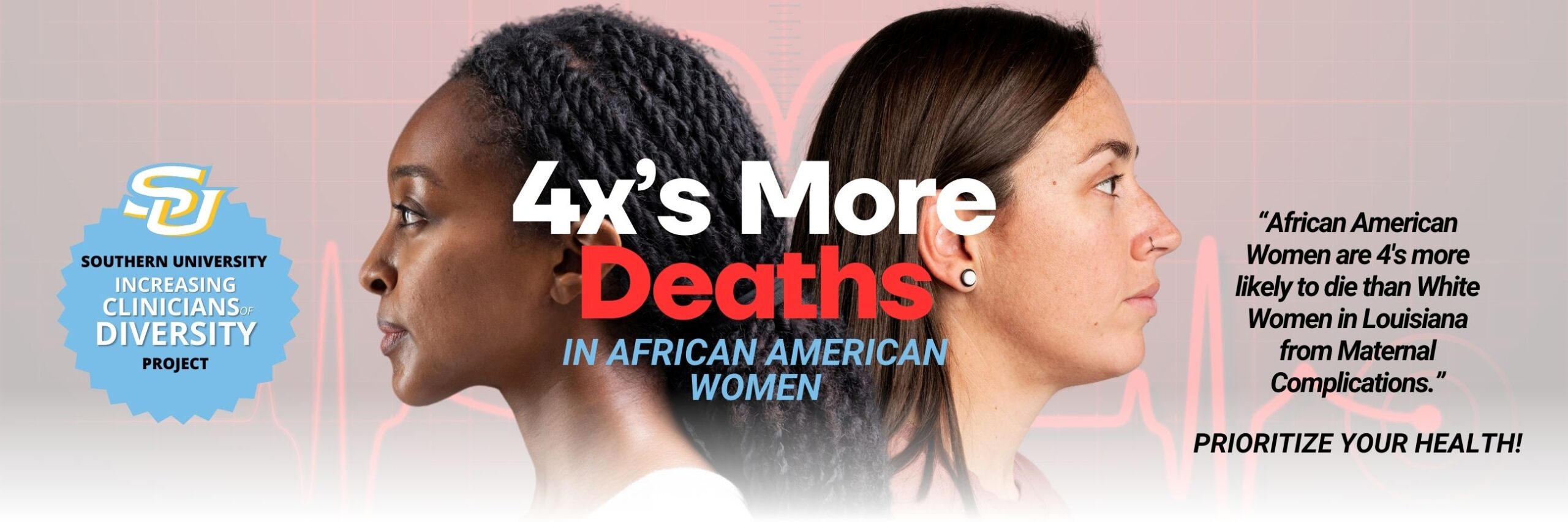
Invest In Women – Secure The Future
The purpose of the Southern University ICOD Project is to bring focus on the zip codes across the state of Louisiana with higher-than-normal maternal mortality rates (death in childbirth or soon after). The World Health Organization reported that the US has one of the highest rates of maternal death in the developed world. Women in the US are 10 times more likely to die from pregnancy-related causes than mothers in Poland, Spain, or Norway. According to a May 17, 2023, article by Consumers for Quality Care, Louisiana experienced the highest maternal mortality rate in the country. Research also shows that there is a higher rate of maternal mortality in the African American (BLACK) community (regardless of income) as compared to all other races. If we spend only $on maternal healthcare, % of deaths can be prevented.

Smoking
20.1%
Hypertension
28.6%
Unhealthy Weight
15.1%
Diabetes
34.7%
Previous Preterm
35.2%
Carrying Multiples
70.8%
PRETERM BIRTH RATES BY PARISHES AND CITY
| Parish | Grade | Preterm Birth Rate | Change in rate from last year |
|---|---|---|---|
| Ascension | D- | 11.4% | Improved |
| Bossier | F | 14.3% | Improved |
| Caddo | F | 17.8% | Improved |
| Calcasieu | F | 13.2% | Worsened |
| East Baton Rouge | F | 12.8% | Worsened |
| Jefferson | F | 12.0% | No change |
| Lafayette | F | 12.2% | Worsened |
| Lafourche | F | 12.9% | Improved |
| Livingston | F | 12.2% | Worsened |
| Orleans | F | 13.5% | Improved |
| Ouachita | F | 16.3% | Improved |
| Rapides | F | 15.4% | Worsened |
| St. Tammany | D+ | 10.5% | Improved |
| Tangipahoa | D- | 11.2% | Improved |
| Terrebonne | F | 13.3% | Worsened |
INFANT MORTALITY
INFANT
MORTALITY
RATE
7.2
U.S. RATE
5.4
The infant mortality rate decreased in the last decade; 416 babies died in Louisiana in 2021
Infant mortality rate per 1,000 live births
8.18.18.78.77.57.57.67.68.08.07.17.17.77.78.08.07.67.67.27.27.27.220122013201420152016201720182019202020212021
The presence of purple (darker color) indicates a significant trend (p <= 0.05)
Note: On November 1st, 2023, the Centers for Disease Control and Prevention released a preliminary report on 2022 infant deaths showing the first statistically significant increase in the U.S. infant mortality rate in over two decades. Read our press release for more information.
Source: National Center for Health Statistics, Period Linked Birth/Infant Death data, 2011-2021.
The infant mortality rate among babies born to Black birthing people is 1.6x the state rate
Infant mortality rate per 1,000 live births
Rate per 1,000 live births, 2019-2021Race/Ethnicity3.93.95.15.15.55.511.211.2051015
APIHispanicWhiteBlack
Notes: API = Asian/Pacific Islander; AIAN = American Indian/Alaska Native.
Source: National Center for Health Statistics, Period Linked Birth/Infant Death data, 2019-2021.
Leading causes of infant death
Percent of total deaths by primary cause, 2019-202120.720.720.420.415.615.66.56.5PTB/LBWBirth defectsAccidentsSUID0.05.010.015.020.025.030.0
Notes: PTB/LBW = preterm birth and low birth weight; SUID = sudden unexpected infant death.
Source: National Center for Health Statistics, Period Linked Birth/Infant Death data, 2019-2021.
MATERNAL HEALTH
Birthing people in Louisiana have a very high vulnerability to poor outcomes and are most vulnerable due to overall physical health
MVI by parish in Louisiana
https://www.marchofdimes.org/peristats/reports/louisiana/report-card-map
Factors related to maternal vulnerability
Higher scores indicate higher vulnerability4040707092929494949498980102030405060708090100
General HealthcareReproductive HealthcarePhysical EnvironmentMental Health and Substance AbuseSocioeconomic DeterminantsPhysical Health
Notes: The Maternity Vulnerability Index (MVI) is a tool used to understand where birthing people in each state may be more likely to have poor outcomes, including preterm birth and maternal death, due to clinical risk factors and other social, contextual, and environmental factors. Visit https://mvi.surgoventures.org.
Source: Surgo Health, Maternal Vulnerability Index, 2023.
CLINICAL MEASURES
The measures below are important indicators for how Louisiana is supporting the health of birthing people
39.0
PER 100,000 BIRTHS
23.5
MATERNAL MORTALITY
This shows the death rate of birthing people from complications of pregnancy or childbirth that occur during the pregnancy or within 6 weeks after the pregnancy ends.
27.9
PERCENT
26.3
LOW-RISK CESAREAN BIRTH
This shows Cesarean births for first-time moms, carrying a single baby, positioned head-first, and at least 37 weeks pregnant.
18.6
PERCENT
15.5
INADEQUATE PRENATAL CARE
Percent of birthing people who received care beginning in the fifth month or later or less than 50% of the appropriate number of visits for the infant’s gestational age.
Source: National Center for Health Statistics, Mortality data, 2018-2021. National Center for Health Statistics, Natality data, 2022.
POLICY MEASURES
Adoption of the following policies and sufficient funding in Louisiana is critical to improve and sustain maternal and infant healthcare
MEDICAID EXTENSION
State has extended coverage for women to one year postpartum.
MEDICAID EXPANSION
State has adopted this policy, which allows birthing people greater access to preventative care during pregnancy.
PAID FAMILY LEAVE
State has required employers to provide a paid option while out on parental leave.
DOULA REIMBURSEMENT POLICY
State Medicaid agency is actively reimbursing doula care.
MATERNAL MORTALITY REVIEW COMMITTEE (MMRC)
State has a federally funded MMRC committee, which is recognized as essential to understanding and addressing the causes of maternal death.
FETAL AND INFANT MORTALITY REVIEW
State has a Fetal and Infant Mortality Review team or teams to identify and review causes of death.
PERINATAL QUALITY COLLABORATIVE (PQC)
State has a federally funded PQC to identify and improve quality care issues in maternal and infant healthcare.
- Legend
- State has the indicated funding/policy
- State reimburses up to $1,500
- State is progressing legislation but not yet active
- State does not have the indicated funding/policy
Brought to you by
SOUTHERN UNIVERSITY
Increasing Clinicians of Diversity Project (ICOD)